Having options is great — but sometimes not knowing which one to move forward with can be overwhelming! In the world of corporate furniture and workspace services, there are multiple paths to improving a space. They often converge in outcome (a more functional, better-looking environment), but each has its own approach, costs, risks, and advantages.
In this article, we explore the 3 R’s we encounter regularly — Reconfiguration, Renovation, and Relocation — and highlight how each brings its own unique value.
Who knows — maybe your next project will even combine all three!
RECONFIGURATIONS
In simple terms, reconfiguration means changing how a space is laid out or how people move through it — without knocking down walls or starting from scratch. It’s often the quickest and most cost-effective way to breathe new life into a workspace. You take what’s already there — desks, partitions, collaborative zones, private offices — and rearrange or repurpose them to better meet the current needs of your team.
Reconfigurations are ideal when teams grow or shift, when hybrid work changes how space is used, or when your layout just isn’t serving you anymore. Sometimes, a smart reconfiguration can unlock better efficiency, collaboration, or energy — all without major disruption.
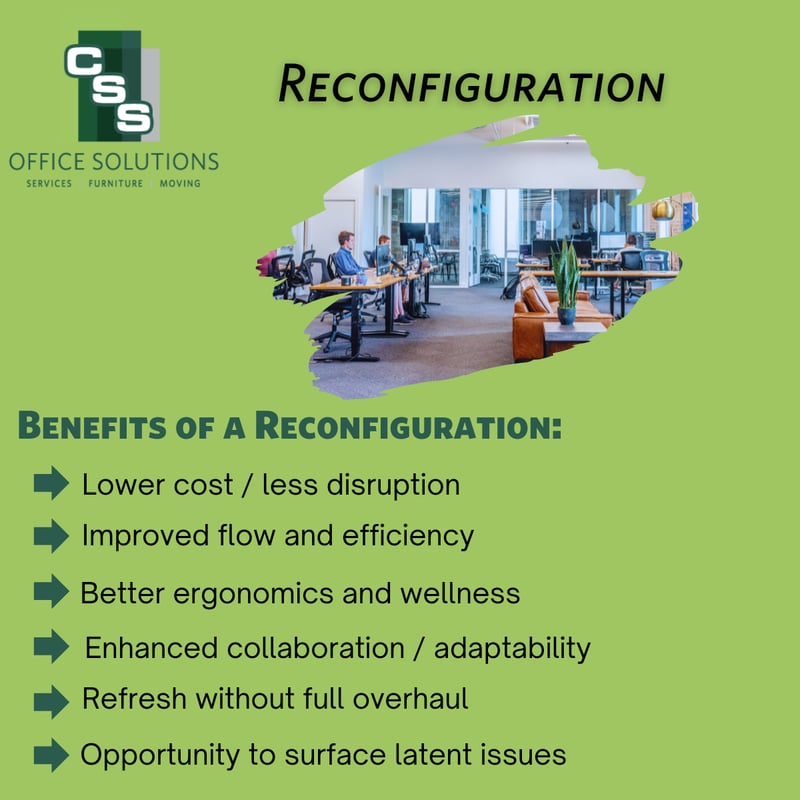
Benefits of a Reconfiguration:
- Lower cost / less disruption: Because you’re reusing existing components and not doing heavy construction, it’s typically much more budget friendly and less intrusive to ongoing operations.
- Improved flow and efficiency: A new layout can reduce wasted walking, bottlenecks, or underutilized zones.
- Better ergonomics and wellness: Adjusting furniture placement, lighting, and circulation can reduce strain and support employee health.
- Enhanced collaboration / adaptability: Reconfiguring allows for more flexible meeting zones, adjacency of teams, or emergence of hybrid/quiet zones.
- Refresh without full overhaul: Sometimes people just get “stuck” in how things are; a thoughtful reconfiguration can bring a fresh, energizing feel without a full renovation.
- Opportunity to surface latent issues: While reconfiguring, you often uncover underused zones or inefficient elements that previously went unnoticed.
RENOVATIONS
Renovations go deeper than reconfigurations. They involve structural or design upgrades — from removing walls and updating flooring to installing new lighting, acoustic panels, or customized millwork. It’s about reimagining a space’s functionality, aesthetic, and flow with a broader scope and longer-term impact.
Whether you’re modernizing an outdated office, adapting for a new workflow, or aligning your space with your brand identity, renovations can deliver a dramatic transformation. They require more planning and investment — but the payoff can be substantial in both employee satisfaction and business performance.
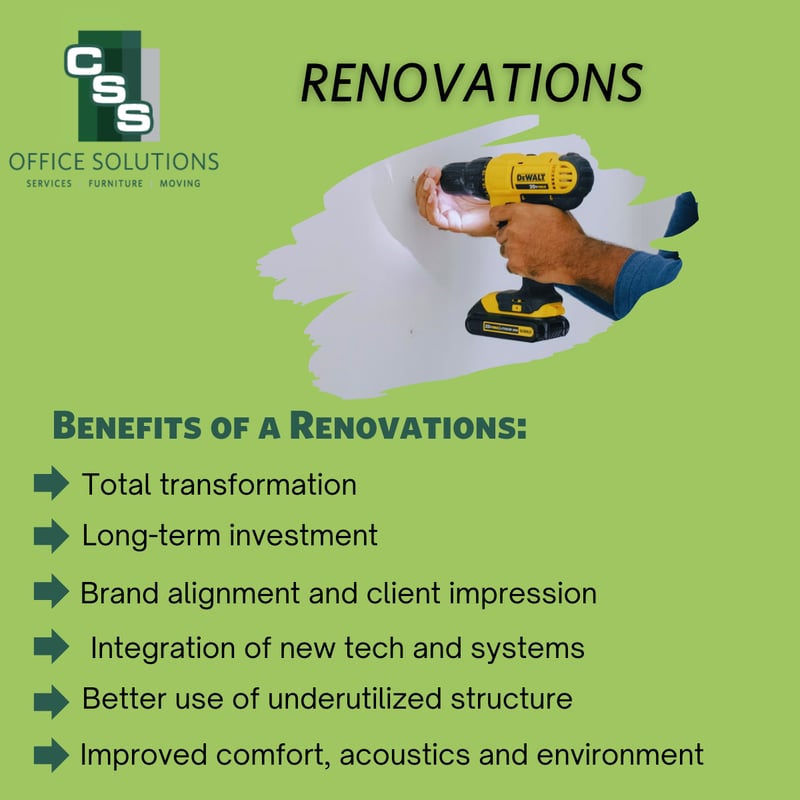
Benefits of a Renovation:
- Total transformation: Renovation gives you the flexibility to tailor the space to your needs — from built-in cabinetry and lighting to acoustics, HVAC, and modern materials.
- Long-term investment: A well-executed renovation can raise property value, reduce maintenance costs, and future-proof infrastructure (i.e.: energy efficiency, wiring).
- Brand alignment and client impression: A modern, polished space reinforces your identity and signals commitment to quality.
- Integration of new tech and systems: When you’re already opening up walls, it’s easier to upgrade wiring, connectivity, AV, and smart systems.
- Better use of underutilized structure: Sometimes walls, columns or support zones limit layout flexibility; renovation allows you to remove or relocate obstacles.
- Improved comfort, acoustics and environment: You can address HVAC, sound control, lighting, insulation — factors that reconfiguration alone can’t fully tackle.
Trade-offs to watch out for:
- Higher cost and more risk: surprises in the existing structure often arise (plumbing, electrical, structural constraints).
- Longer timelines and disruption: operations may need to be phased or relocated temporarily.
- Lease or building restrictions: you may need landlord approval or face limits in what can be changed.
RELOCATIONS
Relocation means a physical move — from one part of the city to another, across town, or even just to a different floor in the same building. It’s a fresh start and a major undertaking all in one. Often prompted by growth, lease expiration, or strategic shifts, relocation opens up opportunities to build the space you need from the ground up — and leave behind what’s no longer working.
A successful relocation involves more than just packing boxes. It’s about choosing the right space, designing it to suit your team and workflow, and orchestrating the move with minimal disruption. With careful planning and the right support team, relocation can be a game-changing reset for your business.
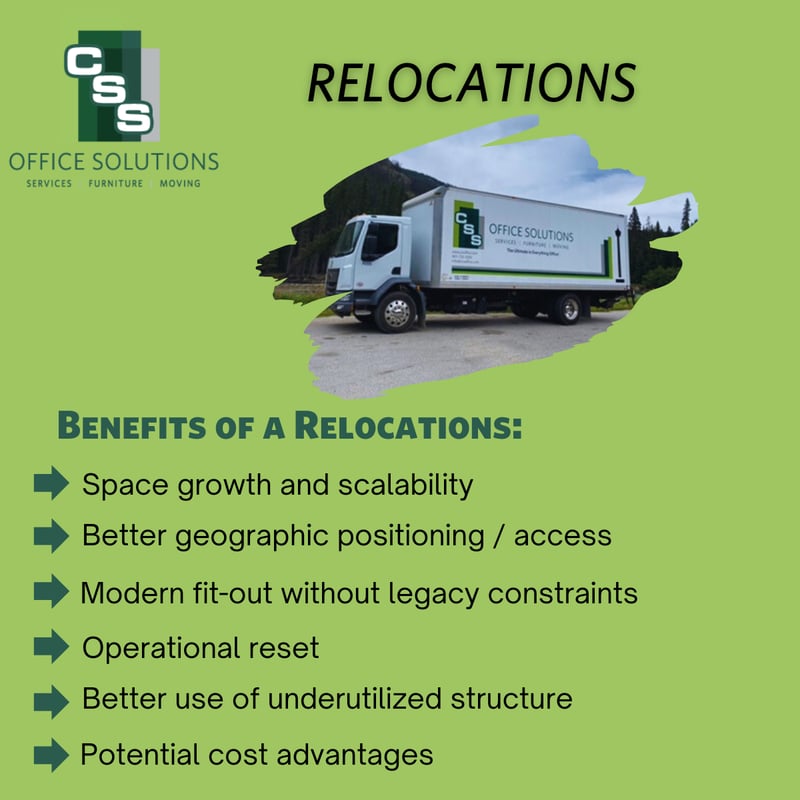
Remember:
- Space growth and scalability: If your current site no longer accommodates your headcount or future growth, a new place gives breathing room.
- Better geographic positioning / access: You can select a location with better access to transit, clients, amenities, prestige, or talent pool.
- Modern fit-out without legacy constraints: You often get a “blank canvas” to build exactly how you want (rather than trying to retrofit).
- Operational reset: A move can serve as a fresh start in culture, layout, systems, and identity.
- Potential cost advantages: In some markets, you may find better lease rates, incentives, or lower operating expenses (i.e.: utilities, taxes).
Challenges to consider:
- Higher upfront expense, including moving, new lease terms, build-out, and downtime.
- Disruption: packing, shifting operations, acclimating teams, and IT transitions.
- Lease surrender costs, lease break penalties, or double rent periods.
- Employee impact: changes in commute, familiarity, client access, morale.
- Possibility that future growth still outpaces your new site if not carefully planned.
Work with a Vendor Who Can Support Reconfiguration, Renovation, or Relocation
No matter which path you choose, having a trusted, experienced commercial furniture + workspace services partner is invaluable.
A strong vendor can:
- Provide honest assessments and options tailored to your goals.
- Leverage modular, adaptable furniture solutions that ease transitions.
- Phase work intelligently to reduce downtime.
- Manage logistics of moving, decommissioning, upgrading systems, and installation.
- Coordinate trades, finishes, and sequencing when renovations are needed.
- Help you “reuse where possible” — i.e.: stripping, refurbishing, repurposing components, which aligns with sustainability goals.
At CSS Office Solutions, we’d love to walk through your vision, audit your space, and help you land on the right “R” (or combination thereof).